
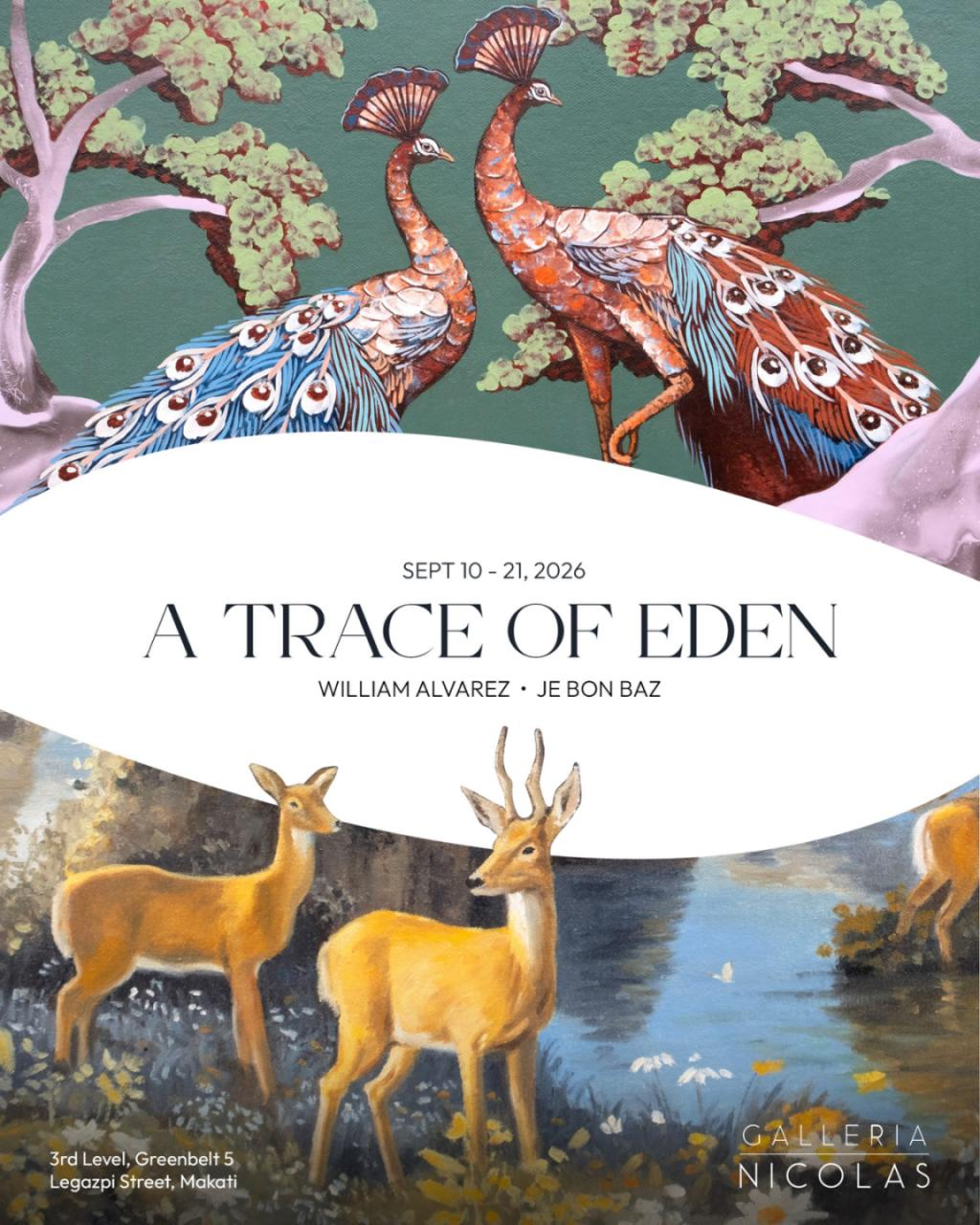
“A Trace of Eden” by William Alvarez and Je Bon Baz
Galleria Nicolas Greenbelt
Sept 10 – 22, 2026
A Trace of Eden brings together Je Bon Baz and William Alvarez in an exploration of paradise as both an imagined landscape and an ideal coexistence. Drawing upon representations of flora, fauna, and idealized natural environments, the exhibition considers Eden beyond its biblical associations, approaching it instead as a metaphor for ecological balance and an unbroken relationship among living beings. Within these works, nature is neither hostile nor governed by competition. It becomes a self-contained order in which wildlife exists in states of mutual accord. The trace suggested by the title consequently points toward something both remembered and desired: the possibility of recovering harmony within a world increasingly defined by separation from nature.
Alvarez approaches this idea through compositions dominated by the peacock, whose elaborate plumage provides both the visual and structural foundation of his paintings. Situated among stylized trees and sculptural branches, these birds possess an almost heraldic presence. Their feathers extend through rhythmic repetitions of line, color, and pattern, transforming biological form into ornament. Yet despite their magnificence, the peacocks do not appear detached from their surroundings. Their forms participate in the landscape, suggesting a continuity between animal and vegetal life. Beauty, in Alvarez’s works, emerges from this formal interdependence rather than from the isolated spectacle of the individual creature.
Je Bon Baz develops a more expansive conception of paradise through imagined landscapes populated by herons, flamingos, and other animals. Rich flora borders bodies of water, mountains, forests, and architectural fragments. These allow the environment to organize spaces that resist geographic specificity. These elements are deliberately composite, bringing together species and terrains that would not ordinarily share the same habitat. Such departures from naturalism allow the paintings to function as propositions rather than records of existing ecosystems. Predator and prey cease to occupy opposing positions; animals inhabit the landscape without visible hierarchy or conflict. The resulting scenes recall the historical tradition of the pastoral and the Arcadian landscape, in which nature becomes a conceptual space for contemplating, an alternative to the disorder of lived reality.
Together, the works of Alvarez and Je Bon Baz establish A Trace of Eden as a meditation on harmony as an ecological and philosophical principle. Their differing approaches—one concentrated and ornamental, the other panoramic and Arcadian—converge upon an understanding of paradise founded on interconnectedness. Eden, in this context, is less a lost geographical place than a model for imagining relationships among living things. The exhibition therefore locates paradise within the possibility of coexistence itself: in environments where difference does not necessitate conflict and where every organism remains part of a larger, interdependent whole. What survives of Eden, these works suggest, may be precisely this impulse to envision nature as a shared world rather than a collection of separate domains.

Oil on Canvas

Oil on Canvas

Oil on Canvas

Oil on Canvas

Oil on Canvas

Oil on Canvas

Oil on Canvas

Oil on Canvas
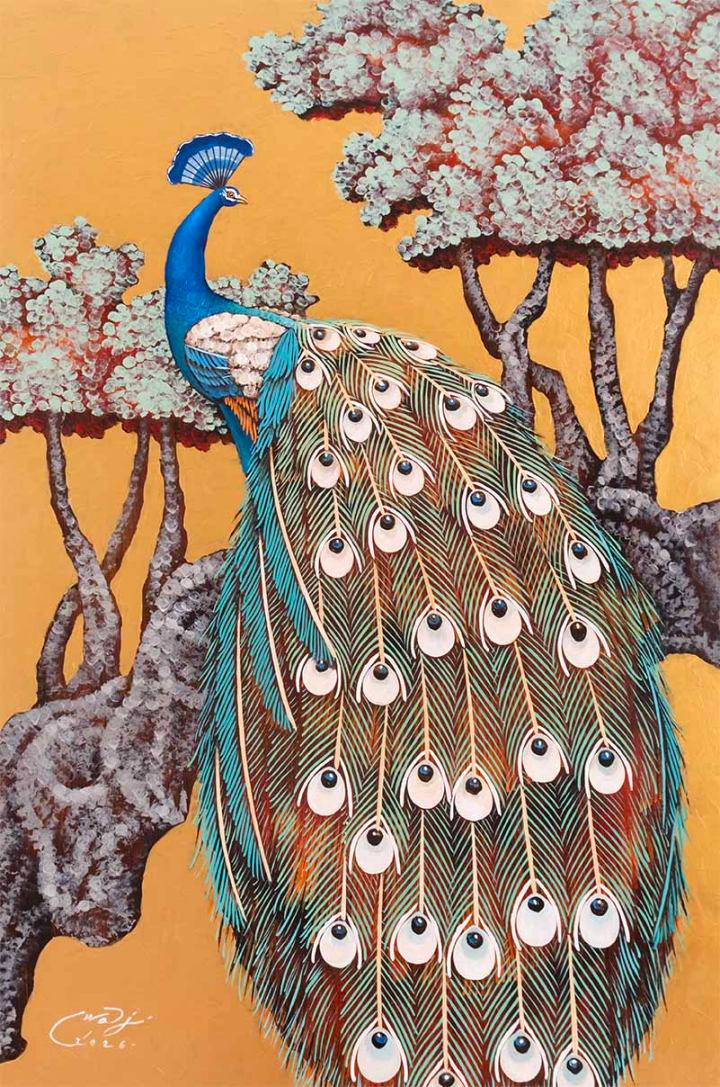
Oil on Canvas
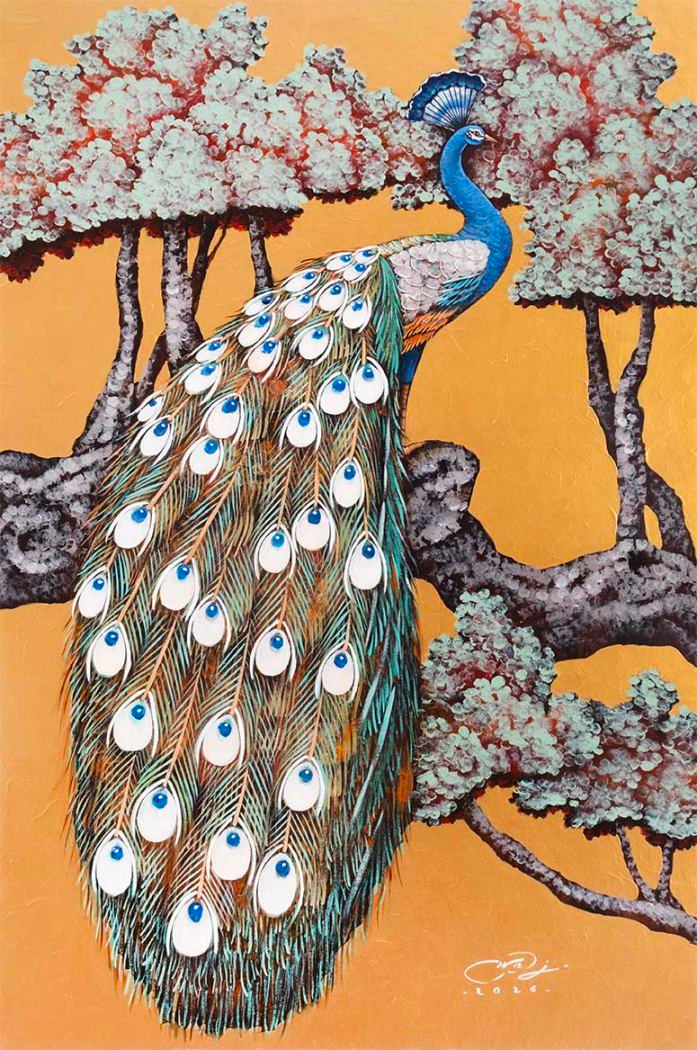
Oil on Canvas

Oil on Canvas

Oil on Canvas

Oil on Canvas

Oil on Canvas

Oil on Canvas

Oil on Canvas

Oil on Canvas

Oil on Canvas

Oil on Canvas

Oil on Canvas